Sometimes, you feel it deep inside.
A quiet discomfort.
A sense that something once pure now feels disturbed.
Maybe it came through a dream, a moment of weakness, or a situation that left your heart uneasy. You didn’t plan it. You didn’t want it. Yet the feeling remains.
This is often when people search for the defile meaning in the Bible.
The word defile sounds heavy. It feels final. Many believers fear it means they are rejected or too far from God. But Scripture tells a gentler, deeper story—one filled with truth, correction, mercy, and hope.
God never reveals something to shame us.
He reveals it to heal us.
So what does it truly mean to be defiled in the Bible?
Is it about losing God’s presence?
Or is it an invitation to restoration?
Let’s explore the biblical meaning together—slowly, clearly, and through the lens of God’s love—so your heart can rest again.
Biblical Meaning of Defile in the Bible
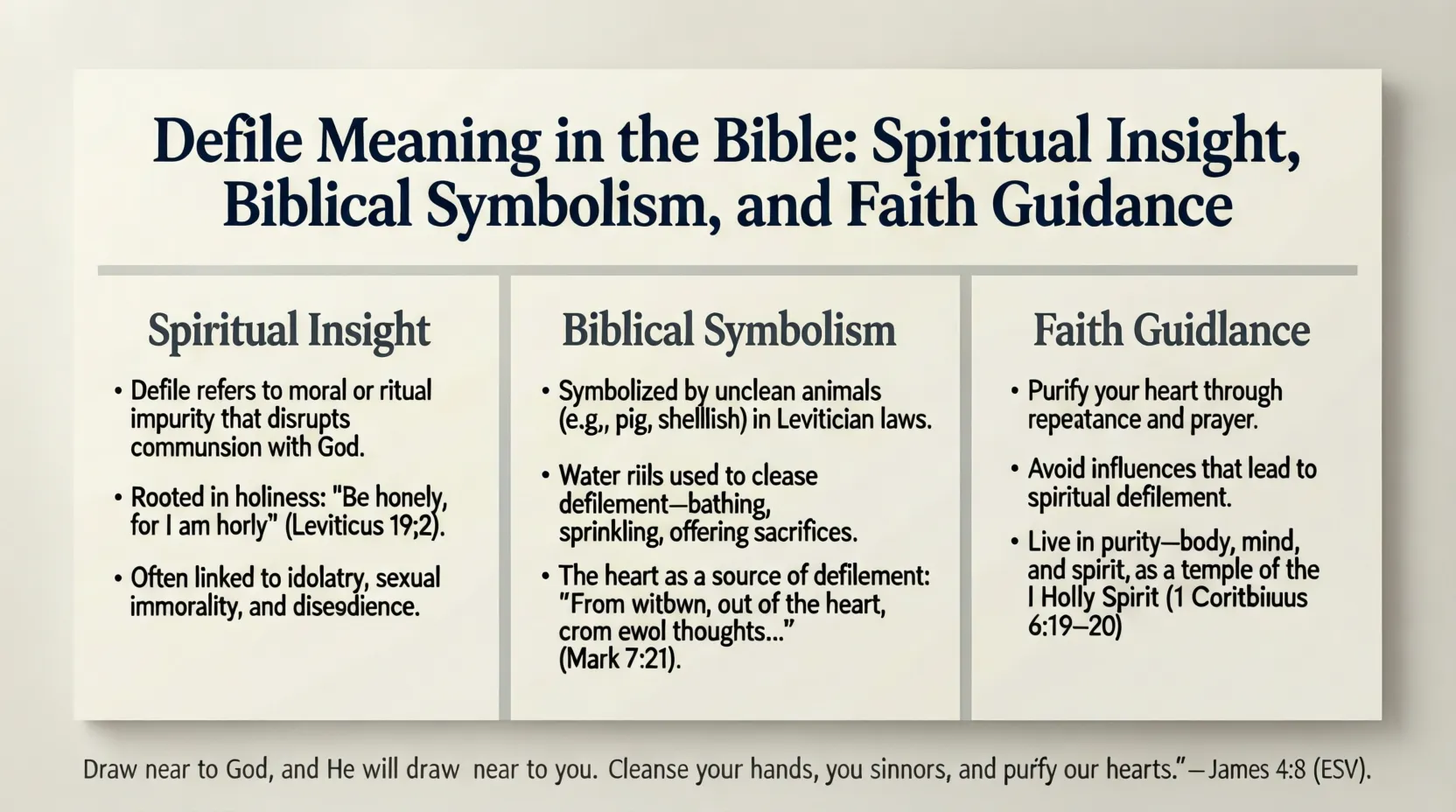
In simple terms, to defile in the Bible means to make something spiritually unclean or polluted, especially in a way that affects one’s relationship with God.
In the Old Testament, defilement was often connected to God’s holiness. God taught His people that He is pure, and those who come near Him should treat life, worship, and their hearts with care.
In Leviticus, defilement is mentioned many times. It includes physical actions, moral choices, and spiritual disobedience. These laws were not meant to punish, but to teach Israel the difference between holy and unholy.
However, as Scripture unfolds, God reveals something deeper.
Defilement Is More Than the Outside
Jesus brings clarity and freedom.
In Matthew 15:18–20, Jesus says that what truly defiles a person comes from the heart, not from the outside world.
This means:
- A person can look clean but feel broken inside.
- A person can make mistakes and still be deeply loved by God.
In Mark 7:21–23, Jesus explains that evil thoughts, pride, envy, and hatred are what defile a person—not food, not appearances, not rituals.
This shifts everything.
Defilement is about the condition of the heart, not about being beyond grace.
Warning and Hope in the Same Word
The Bible uses defilement as a warning, but also as an invitation.
- A warning to stay close to God
- A reminder that sin affects the soul
- A call to repentance, not despair
In Isaiah 1:18, God says that even if sins are like scarlet, He can make them white as snow.
Defilement is never the end of the story.
Redemption always has the final word.
Spiritual Significance and Symbolism
Spiritually, defilement represents a distance between the soul and God’s peace. Not because God leaves, but because the heart feels heavy, distracted, or burdened.
Many believers experience this during:
- Spiritual dryness
- Guilt after sin
- Loss of prayer focus
- Compromised values
But here is the beautiful truth:
Feeling defiled often means your spirit is still sensitive to God.
A hardened heart feels nothing.
A living faith feels conviction—and conviction leads to growth.
Defilement, in spiritual symbolism, points to:
- A need for cleansing
- A call to self-reflection
- An opportunity for spiritual awakening
Just like washing restores the body, repentance restores the soul.
In daily life, this may look like:
- Pausing before prayer and asking God to search your heart
- Letting go of bitterness you’ve carried quietly
- Turning back to Scripture after drifting away
God does not demand perfection.
He desires honest hearts.
Biblical Interpretations in Dreams or Real Life
Many people encounter defilement in dreams—dirty clothes, polluted water, broken temples, or stained objects.
Biblically, these images often reflect the inner state of the heart, not a prediction of doom.
- Gentle or quiet defilement in a dream may show hidden guilt or spiritual neglect.
- Fearful or disturbing defilement can be a strong call to repentance and prayer.
- Cleansing after defilement is a powerful sign of God’s forgiveness and renewal.
In real life, feeling defiled may come after compromise, temptation, or emotional wounds. The Bible encourages believers not to ignore this feeling, but to bring it to God.
In 1 John 1:9, Scripture promises that if we confess our sins, God is faithful to forgive and cleanse us from all unrighteousness.
That includes defilement.
Practical Lessons & Faith Insights
- God reveals, not rejects
- Conviction is a sign of spiritual life
- Cleansing comes through prayer and repentance
- Grace is always greater than failure
Take time to pray.
Ask God to renew your heart.
Trust that His mercy is enough.
Conclusion: From Defilement to Restoration
The defile meaning in the Bible is not about condemnation. It is about restoration.
God shows us what is unclean so He can make it clean again. He points out the stain so He can wash it away. Through faith, prayer, and repentance, defilement becomes a doorway to deeper intimacy with Him.
You are not lost.
You are being invited closer.
Let God cleanse your heart—and walk forward in peace, hope, and renewed faith.