Imagine this moment.
You are tired, burdened, or quietly praying for help. Then a gentle thought fills your heart — mercy. Not judgment. Not punishment. Just mercy. 💛
Many people feel this word during prayer, see it in a dream, or hear it repeated in their spirit during hard times. It feels soft, yet powerful. Comforting, yet life-changing. Naturally, the question rises: what is the mercy meaning in Bible, and why does it touch the soul so deeply?
In the Bible, mercy is more than kindness. It is God stepping toward broken people with open arms. It is forgiveness when punishment is deserved. It is love that refuses to let go.
For some, mercy appears during repentance. For others, it comes during fear, guilt, or sorrow. It often arrives when hope feels weak — like light breaking through clouds.
So what does mercy truly mean in Scripture?
Is it only forgiveness, or something greater?
Could it be a divine message meant just for you?
Let’s gently explore the biblical meaning of mercy, its spiritual symbolism, and how it connects to your faith journey today.
Mercy Definition in the Bible (KJV)
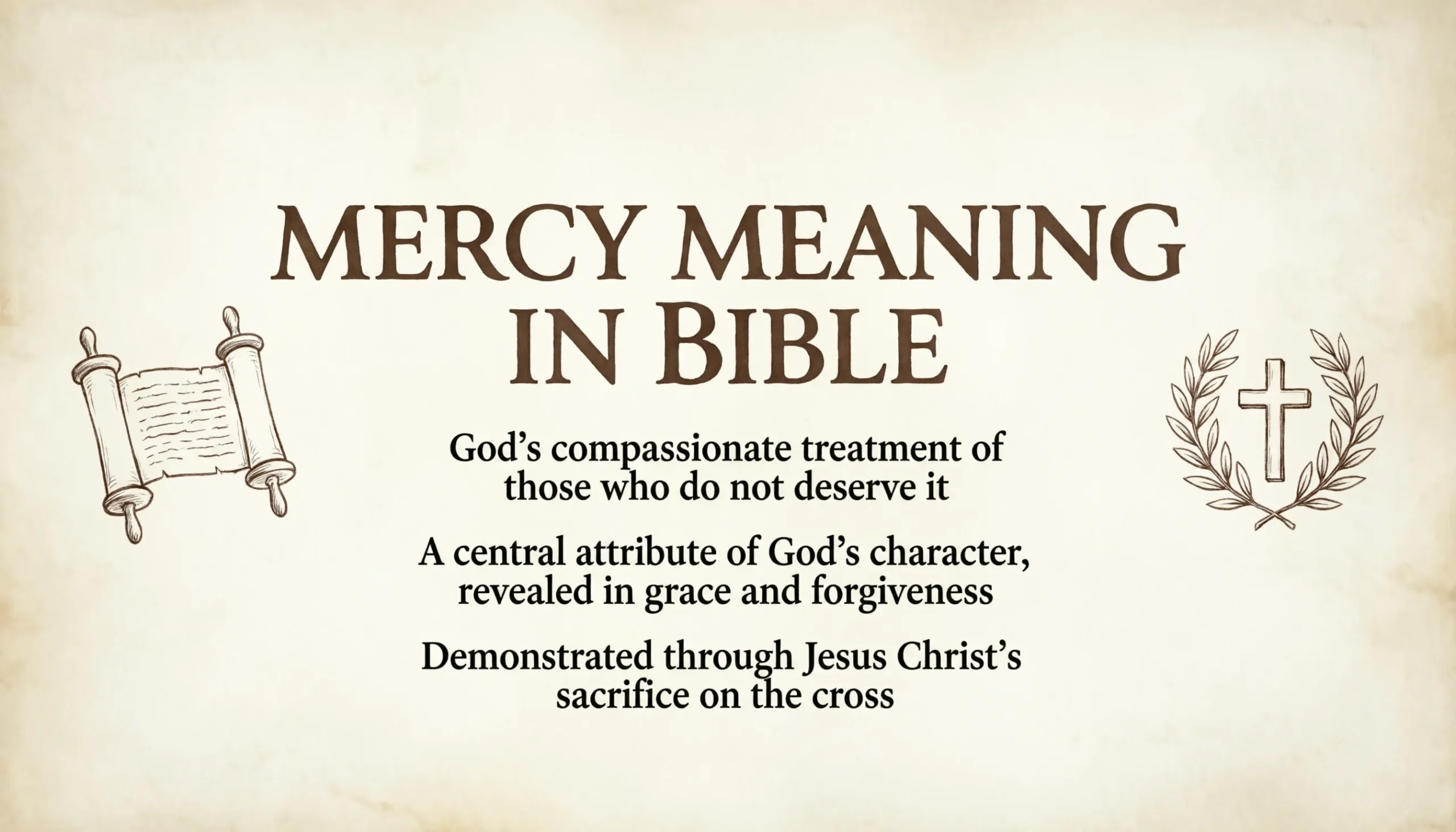
In the King James Version (KJV) Bible, mercy means God’s compassion, kindness, and forgiveness toward people who are weak, sinful, or suffering, even when they do not deserve it.
📖 Biblical Meaning of Mercy (KJV)
Mercy in the Bible includes:
- Forgiveness of sins
- Compassion toward the suffering
- Withholding deserved punishment
- Kindness from God toward sinners
- Loving help in times of need
In simple terms:
Mercy means God not giving us the punishment we deserve and instead showing kindness and forgiveness.
📜 Hebrew Meaning of Mercy (Old Testament)
Chesed (חֶסֶד)
Meaning:
- Loving-kindness
- Steadfast love
- Mercy
- Covenant loyalty
This is one of the most important Hebrew words in the Bible.
It describes:
- God’s faithful love
- His unchanging kindness
- His mercy toward His people
📜 Greek Meaning of Mercy (New Testament)
Eleos (ἔλεος)
Meaning:
- Mercy
- Compassion
- Pity
- Kindness toward the suffering
It emphasizes:
- heartfelt compassion
- action to help those in need
📖 Key Bible Verses (KJV)
Lamentations 3:22
“It is of the LORD’s mercies that we are not consumed, because his compassions fail not.”
👉 This shows mercy as God’s continuous compassion.
Ephesians 2:4–5
“But God, who is rich in mercy, for his great love wherewith he loved us…”
👉 Mercy comes from God’s love and grace, not human merit.
Matthew 5:7
“Blessed are the merciful: for they shall obtain mercy.”
👉 Those who show mercy will also receive mercy.
🌿 Types of Mercy in the Bible
1. Divine Mercy
- God forgiving sinners
- God saving and restoring people
2. Human Mercy
- Showing kindness to others
- Forgiving those who hurt us
Spiritual Meaning of Mercy
The spiritual meaning of mercy is the expression of compassion, forgiveness, kindness, and undeserved love shown toward others. In a spiritual sense, mercy represents the willingness to show grace even when someone has made mistakes, fallen short, or does not deserve kindness. It reflects a heart that chooses understanding and forgiveness instead of judgment.
In many faith traditions, especially Christianity, mercy is seen as one of the greatest qualities of God. The Bible describes God as merciful, patient, and loving, offering forgiveness and restoration to those who seek Him. Mercy is not simply ignoring wrongdoing; it is the act of responding with love, compassion, and a desire for healing.
Spiritually, experiencing mercy can symbolize:
- Forgiveness and second chances – Mercy reminds us that mistakes do not have to define a person’s future.
- God’s unconditional love – It represents divine compassion and the grace given to humanity.
- Humility and compassion – Showing mercy teaches us to treat others with kindness and understanding.
- Inner healing – Receiving and giving mercy can bring emotional and spiritual peace.
- A transformed heart – Mercy encourages people to move away from anger, pride, and resentment.
Mercy Meaning in Hebrew
The Hebrew meaning of mercy is closely connected with compassion, kindness, forgiveness, and deep love. In the Old Testament, several Hebrew words are translated as “mercy,” but the most important one is “racham” (רָחַם) and “chesed” (חֶסֶד).
1. Racham (רָחַם) — Compassion and Tender Mercy
The Hebrew word racham (rachamim in its plural form) refers to deep compassion, tender love, and a heartfelt feeling of care for someone. It is often connected with the Hebrew word “rechem” (רֶחֶם), meaning “womb,” symbolizing the tender, protective, and nurturing compassion a mother has for her child.
In the Bible, this word describes God’s compassionate nature. It shows that God’s mercy is not cold or distant but filled with love, patience, and a desire to restore.
Example:
“The LORD is compassionate and gracious, slow to anger, abounding in love.” — Psalm 103:8
This reflects the idea of God showing racham—deep mercy and compassion toward His people.
2. Chesed (חֶסֶד) — Loving-Kindness and Covenant Mercy
Another major Hebrew word for mercy is chesed (hesed). It means steadfast love, kindness, faithfulness, and loyal compassion. It describes a love that remains committed even when people fail.
In Scripture, God’s chesed represents His faithful mercy and His promise to care for His people.
Example:
“Give thanks to the LORD, for He is good; His mercy endures forever.” — Psalm 136:1
The “mercy” mentioned here comes from the idea of chesed—God’s unfailing love that continues through generations.
Biblical Meaning of Mercy
The mercy meaning in Bible is deeply tied to God’s character. Mercy means God’s compassionate response to human weakness, sin, and pain.
In simple terms, mercy is love in action.
Mercy in the Old Testament
In Hebrew, mercy often comes from the word “chesed”. It means:
- Loving-kindness
- Faithful love
- Covenant compassion
This tells us that God’s mercy is not temporary. It is faithful and lasting.
“The LORD is merciful and gracious, slow to anger, and abounding in steadfast love.”
— Psalm 103:8
God does not rush to punish. Instead, He waits with patience, giving people time to turn back to Him.
“Because of the LORD’s great mercy we are not consumed.”
— Lamentations 3:22
Here, mercy is protection. It is the reason we are still standing.
Mercy in the New Testament
In the New Testament, mercy shines through Jesus Christ.
Jesus healed the sick, forgave sinners, and welcomed the rejected. Over and over, people cried:
“Lord, have mercy on me!”
— Matthew 20:30
And Jesus answered with compassion.
“Blessed are the merciful, for they shall obtain mercy.”
— Matthew 5:7
This shows that mercy is both received and shared. God gives mercy freely, and He invites us to reflect it to others.
Positive and Warning Meanings
Positive meaning of mercy:
- Forgiveness of sins
- God’s patience with our failures
- Healing and restoration
- Hope for a new beginning
Warning meaning:
Mercy should not be ignored or abused.
“Do you show contempt for the riches of His kindness, forbearance and patience?”
— Romans 2:4
Mercy calls us to repentance, not rebellion.
In the Bible, mercy is God saying, “Come back. I still love you.”
Spiritual Significance and Symbolism
Spiritually, mercy represents God’s heart reaching toward humanity. It is a sign that He sees pain, weakness, and regret — and responds with grace.
Mercy teaches us that:
- We are not defined by our past
- Failure is not the end
- God’s love is stronger than sin
In a Christian life, mercy often appears during moments of spiritual awakening. You may feel:
- A desire to forgive someone
- A call to let go of guilt
- Peace after confession
- Comfort during prayer
This is not coincidence. It is the presence of God working gently within you.
Think of mercy like rain on dry ground. 🌧️
It does not shout. It nourishes quietly.
When believers grow spiritually, they begin to:
- Show patience
- Choose forgiveness
- Walk humbly
- Trust God’s guidance
Mercy transforms hearts — first ours, then others.
Biblical Interpretations in Dreams or Real Life
Many people experience mercy as a spiritual message in dreams or daily life.
Dreams About Mercy
- Feeling forgiven in a dream: God may be assuring you of His grace
- Hearing the word “mercy”: A call to prayer or repentance
- Being shown kindness: A reminder of God’s care
Real-Life Experiences
- Unexpected forgiveness from someone
- Peace after confessing sin
- Help arriving at the last moment
These moments reflect biblical symbolism of mercy — God intervening with love.
If mercy feels gentle and calming, it often signals reassurance.
If it feels urgent, it may be a call to return to God.
Always seek understanding through prayer and Scripture.
Practical Lessons & Faith Insights
Mercy teaches us to:
- Forgive as God forgives
- Trust God’s timing
- Release guilt and fear
- Walk in humility
When you feel mercy, pause. Pray. Reflect.
God may be guiding you toward healing or renewal.
Conclusion
The mercy meaning in Bible reveals a God who chooses love over punishment and compassion over anger. Mercy is His gentle invitation to healing, forgiveness, and hope.
Whether you felt mercy in prayer, a dream, or life itself, remember this: God’s mercy is new every morning.
Let it lead you closer to Him.
Let it soften your heart.
And let it remind you that you are deeply loved — always